
Accelerate returns
in volatile markets.
The right digital or AI intervention at the right stage moves value faster than most funds expect. We identify the lever, build the case, and execute.
The conditions that erode
portfolio returns are well known.
With leverage costs elevated and holding periods extending, operational performance is now the defining variable. For impact funds, the challenge compounds: portfolios must deliver financial returns and credible outcome evidence simultaneously. The gap between what portfolio companies can do today and what the thesis requires is consistently the largest unaddressed risk in the deal.
Data that cannot support decisions
The data that manages operations today rarely supports AI, dynamic pricing, or LP-grade outcome reporting. The gap only becomes visible when it is already expensive.
Interventions that do not connect
Digital and AI projects executed in isolation rarely move value at the scale the thesis requires. The interaction between initiatives is where returns are made or lost.
Technology built for the wrong scale
Systems built for 50,000 clients rarely scale to 200,000 without significant remediation — cost that surfaces only after close.
Execution capacity assumed, not built
The skills required to run a value creation programme differ from the skills that built the current business. That gap is common and often invisible until progress stalls.
Integration is what determines
whether an intervention moves value.
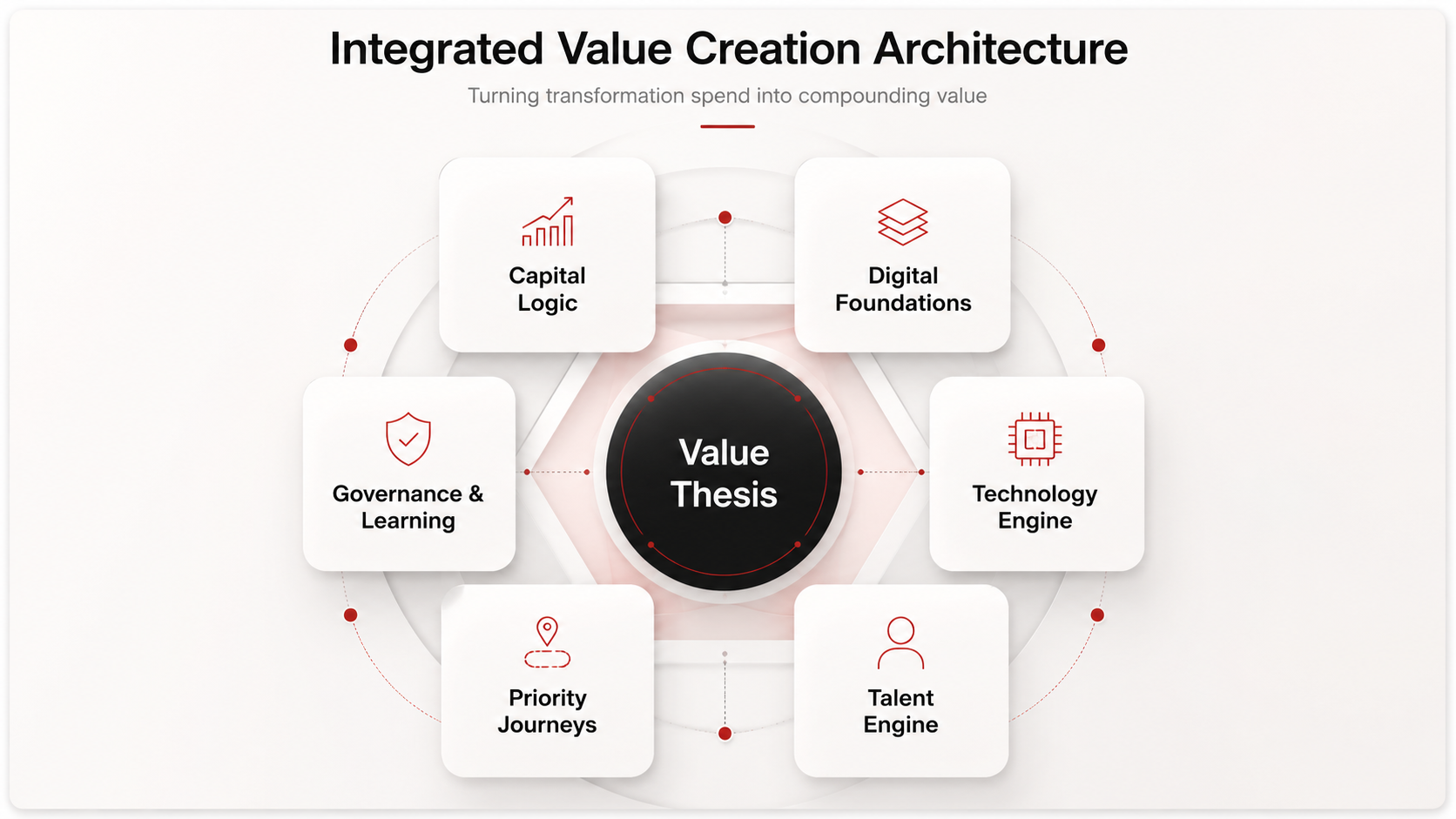
The Integrated Value Creation Architecture is the discipline Accendo applies to any engagement, large or small, ensuring that a digital or AI project connects to the right data, governance, people, and metrics. Isolated interventions, however well executed, rarely move value at the scale the thesis requires.
Defines outcomes explicitly
Not activity metrics, but value outcomes the fund can take to the IC or LP: client performance, institutional resilience, and shareholder returns. The value thesis sits at the centre of every engagement.
Specifies where value is created
Through three interdependent engines: technology and data, talent and organization, and client journey and value. No engine advances in isolation. A treasury automation that bypasses the reporting and governance layer delivers nothing the fund can measure.
Enforces sequencing
Investments are staged against data integrity, governance maturity, workflow integration, and organizational absorption capacity. The same intervention can compound value in one institution and destroy it in another depending on sequencing discipline.
Embeds learning as a design requirement
Engagements that do not retain feedback, compound improvements, or distribute learning are treated as risks. Every programme must improve over time, not just deliver at inception.
Uses value metrics as governing gates
Financial and client metrics determine whether a programme continues, pauses, or is redesigned. Pause scale if productivity does not improve. Redesign if client retention deteriorates. Reallocate capital if cost-to-income fails to move. Value metrics gate every next decision.
The first 90 days establish
what is moving and what is not.
The method is deliberately tight. It creates enough structure for comparability across a portfolio, but stays practical enough for mid-market institutions that do not have unlimited management bandwidth. It applies whether the engagement is a contained AI project or a broader value creation programme.
Align
Clarify the investor thesis, management ambition, constraints, and the value levers that matter most for this institution at this stage.
Baseline
Assess business model, technology, data, customer journeys, people, risk, and impact evidence. Identify where value is being created and where it is leaking.
Prioritize
Rank interventions by value potential, doability, dependency, risk, and organizational absorption capacity. Cut the list to what management can actually deliver.
Roadmap
Build a 90-day and 12-month plan with owners, costs, KPIs, decision gates, and stop or pivot rules for early execution.
Track
Run a monthly value cadence using lead, lag, and counter metrics. Value metrics gate every next phase of investment.
Allocate capital and attention
where the evidence points.
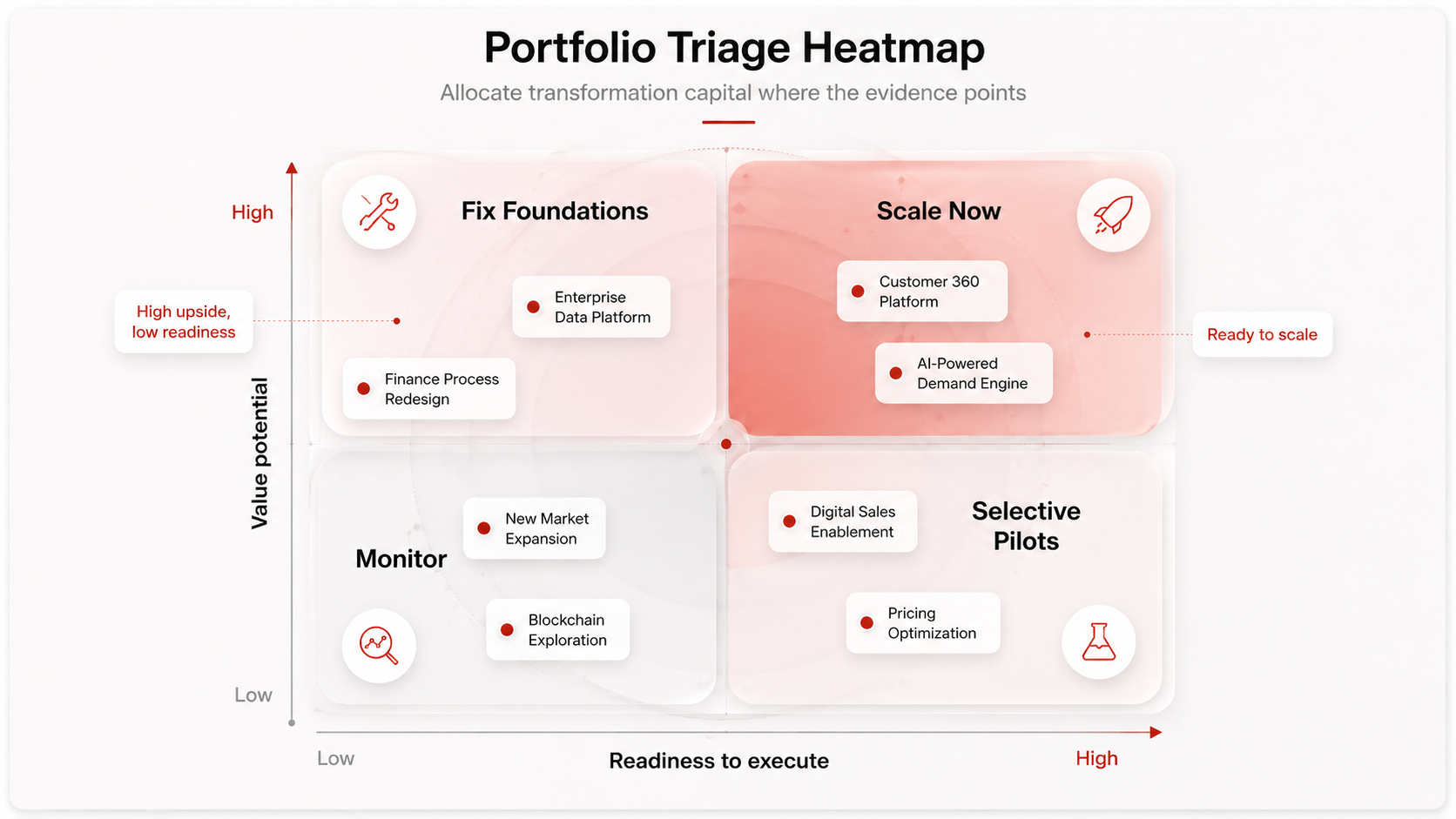
Most funds cannot deeply support every portfolio company at the same time. Accendo segments the portfolio so time, technical assistance, and investment go where the value case and readiness justify the effort. The triage heatmap sequences interventions by value potential, readiness, and risk before commitments are made.
Use the heatmap at two levels: comparing companies across a portfolio, and comparing interventions inside a single company. The goal is a smaller, better-sequenced pipeline.
Three ways to engage.
One value creation logic.
Engagements are scoped to what the value thesis actually requires. A contained digital or AI project, a post-investment sprint, or sustained operating support across a hold period all follow the same underlying logic: identify the right lever, integrate it properly, and measure what moves.
Portfolio diagnostic
Comparable baseline across portfolio companies. Segments institutions by readiness, value potential, risk, and the scale of intervention the thesis warrants.
Value creation sprint
Focused engagement with management to identify the right interventions, build the business case, and launch execution — from a contained AI project to a broader operating programme.
Embedded operating support
Ongoing governance, execution discipline, and coaching across the hold period. Tracks results, removes blockers, and prepares board-ready evidence that value metrics are moving.
Build the value case in
from day one.
Funds generating differentiated returns treat digital and AI interventions as investment decisions, not post-close activities. We identify the lever, build the case, and stay close to execution so the thesis produces evidence the market rewards.
Talk to us →