

Impact Investors Learning
and Building Together.
The AI Circle is a peer community run by Accendo Associates for impact investors adopting AI to increase speed to impact and financial returns. Members learn and build together across the investment lifecycle, in equity and debt, debate the merits and challenges of AI in emerging markets, and explore co-investments. The first members are teams from the five funds of Cohort 1, which ran from July to September 2026: SPE Capital, the Accion Digital Transformation Fund, elea, LocFund Next and Shell Foundation.
The AI Circle is a membership community. Membership starts with training that applies AI to an investor’s own workflow, through an AI Circle Intensive or an AI Circle Cohort. Training comes first so that members start from a similar baseline before they build together. It builds what we call the Fund AI.OS, the fund’s own AI operating system: prompts, skills and AI agents applied to the fund’s workflow. Level 1 covers the skills and prompts a team runs in its AI assistant (Claude, Microsoft Copilot or ChatGPT), Level 2 covers agent-based automations, and Level 3 covers invest-tech platforms that automate whole workflows. The Fund AI.OS is a fund-level asset rather than a set of tools for individuals, so the fund keeps what it builds when people move on. The community shares ideas, explores co-investment opportunities, and receives updates through the newsletter, Accendo Signals, as well as webinars and in-person gatherings.
The AI Circle also works for development finance institutions and other limited partners, on two fronts. Their own investment teams face the same questions as their fund managers, from manager due diligence and macro early warning to portfolio monitoring, and can build their own AI standards alongside them. Membership also gives an LP the grounding for informed discussions with its managers at advisory committee meetings, about how they use AI internally and with portfolio companies, how they govern it, what technical assistance they need, and how future funds could be designed. Funders can commission a dedicated program around their own priorities, such as AI in ESG work, so every manager that goes through it works to the same AI standards, policies and reporting. Talk to us about a funder program.
The impact investing sector carries a large mandate: more than 3 billion people remain underserved, based on the average of five global benchmarks (GSMA, WHO and UNICEF, Brookings, FAO).
Funds carry that mandate with lean teams and rising expectations. Limited partners now ask their general partners how AI is used in the investment process, how its use is governed, and how it can accelerate value creation inside portfolio companies. Portfolio company boards are asking for AI strategies and policies of their own. Few managers are ready with an answer. Most are adopting AI one person at a time, often on personal accounts, with no shared method or written rules. In our July 2026 baseline, a written AI use policy scored 2.25 out of 5 across five impact funds. The wider industry shows the same gap: only 9% of private equity firms are confident they could pass an AI governance audit within 90 days, while 80% are already exploring or piloting agentic AI (Grant Thornton, 2026 AI Impact Survey). As agents begin to act on fund data, a limited partner faces portfolio data leaving its managers’ control, uneven reporting, and no consistent view of how its managers use AI. In the Global Impact Investing Network’s 2025 survey of 258 impact investors, 76% did not name AI as a challenge for their organization (GIIN, State of the Market 2025, October 2025). Of 29 impact equity managers in Africa, Asia and Latin America that we reviewed in September 2026, only two describe in public how AI is used in their own investment process (Accendo Associates desk research, September 2026).
The gap matters because AI speeds up the work at the center of a fund’s economics: screening the pipeline, due diligence, investment committee papers, portfolio monitoring and reporting to limited partners. A fund that builds these workflows on its own documents, with clear rules on data and review, can assess more opportunities and support more portfolio companies with the same team. A fund that leaves AI to individual habit carries the risk without the gain, and loses what people have built when they leave.
Built for Impact Funds Managing
USD 100 to 500 Million.
The AI Circle is built for impact fund managers with USD 100 million to USD 500 million in assets under management, counted across all their funds, whose teams already use AI assistants and want to move to shared tools and automated workflows across the fund. A 2% management fee on a fund of that size covers a small team, with nothing to spare for in-house AI specialists, so the capability has to be built by the people already there. Funds at the upper end of the range have more room to act, and they also face harder questions about AI from portfolio companies and limited partners. Members are managing partners, investment directors, and operations and portfolio leads who have been through an AI Circle Intensive or an AI Circle Cohort.
A decision process
You run an investment committee, or an equivalent body that decides on individual transactions. Equity funds, debt funds and grantmaking foundations all qualify.
Accountability to others
You report to limited partners, a board or funders who will ask how your fund governs its use of AI.
People ready to use it
At least one person on your team already uses an AI assistant and has time to build on it.
New to AI tools
If your team has not used an AI assistant yet, start with Set Your Baseline, a free one-hour session, before an AI Circle Intensive or an AI Circle Cohort.
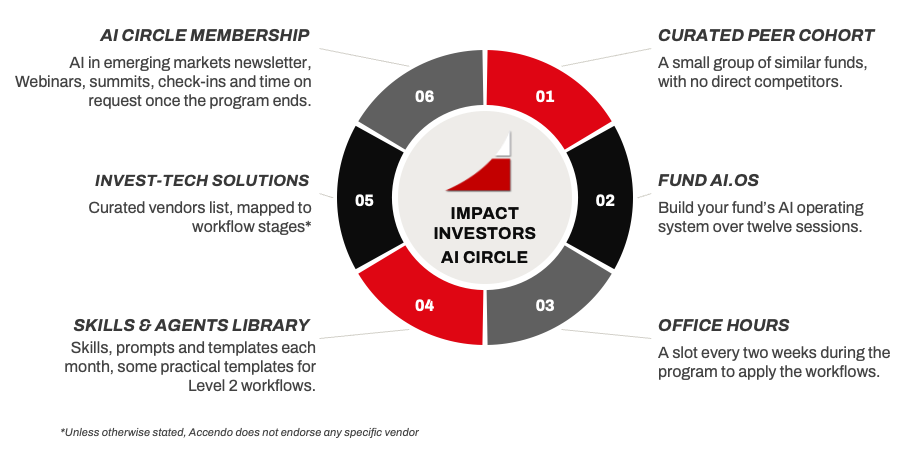
Every Member Gets Three Things.
Cohort Members Get Three More.
For questions about membership or a bespoke program, contact us.
Teams From the Following Funds Are
Cohort Members of the AI Circle Today.





The biggest shift for us was going from asking how each person can use AI to thinking about how the fund itself can work differently with AI.
I joined the AI Circle hoping to build a broader understanding of AI. What surprised me most was not only the capability of the technology, but how accessible it already is and the potential it offers to rapidly scale social impact in ways that were previously difficult to imagine.
Readiness Rose 23% in Six Weeks, From 2.81 to 3.47 Out of 5.
The same eight participants from five funds scored their fund’s practice before the first cohort in July 2026 and again after it in September. Scores for approved AI assistants and a documented AI use policy, the two governance measures that started lowest, rose by about 40%. Everyday confidence, already the highest, rose 10%, and the average across the four measures rose 23%.
| Measure | July | September | Change |
|---|---|---|---|
| Approved AI assistants with clear guidance | 2.50 | 3.50 | +1.00 (+40%) |
| Documented AI use policy | 2.25 | 3.13 | +0.88 (+39%) |
| Confidence with AI for everyday tasks | 3.63 | 4.00 | +0.38 (+10%) |
| AI in impact data collection or reporting | 2.88 | 3.25 | +0.38 (+13%) |
| Average of the four | 2.81 | 3.47 | +0.66 (+23%) |
Scale 1 to 5. 32 paired scores: 13 rose, 14 were unchanged and 5 fell. Source: Accendo Associates AI readiness survey, July 2026, and post-program survey, September 2026.
Membership Starts With an AI Circle Intensive
or an AI Circle Cohort.
AI Circle Intensive
Five hours across two mornings for one person, at USD 750. It covers all eleven stages of the investment lifecycle for equity funds, debt funds and foundations, and you leave with your own lifecycle marked up and one stage run to a working result on your own material.
See the dates and register →AI Circle Cohort
Nine sessions over about six weeks, with three team members per fund included in the fee. Your team works through the investment lifecycle on its own documents alongside a small group of similar funds, and builds its own AI operating system along the way.
See the cohorts and register →If your team is new to AI tools, start with Set Your Baseline, a free one-hour session on Mondays at 07:00 New York. It sorts out tool access and the basics before you commit to either path.
Funders who want a program for their own portfolio companies can commission a bespoke version, scoped and priced with them. Talk to us about a portfolio program.
Gatherings Keep
the Conversation Going.
The AI Circle is a community, and meeting regularly matters. We organize webinars, meetups and summits for members and invited guests, often alongside major industry events.
Choose Where to Start.
Find the Right Place to Start.
Set Your Baseline. It is a free one-hour session on Mondays at 07:00 New York, and you leave with a working result of your own. It does not include membership. Register for Set Your Baseline.
Take the AI Circle Intensive. It is five hours across two mornings, open to individuals, and covers all eleven stages of the investment lifecycle. It includes six months of membership. Register for an AI Circle Intensive.
Join an AI Circle Cohort. Your fund works on its own documents alongside a small group of similar funds, with twelve months of membership. Register for an AI Circle Cohort.
Through an AI Circle Cohort, which carries twelve months of membership, or an AI Circle Intensive, which carries six. Set Your Baseline does not include membership.
The skills and agents library, the invest-tech solutions list, Accendo Signals, webinars, invitations to gatherings and check-ins. Members of an AI Circle Cohort also get a curated peer cohort, their own Fund AI.OS and office hours.
Yes. The fit test is the decision process: if you run an investment committee or an equivalent body that decides on individual transactions, the material applies. Equity and debt funds work together, and grantmakers qualify on the same test.
The cohorts are designed for fund managers with USD 100 million to USD 500 million in assets under management, counted across all their funds. If your fund is smaller, the AI Circle Intensive is a good place to start, because it is priced per person. Larger funds usually build in-house teams, and Accendo supports them through its advisory services. Funders who want a program for their portfolio companies can commission a bespoke version. Contact us.
The cohort runs three plenary sessions of 60 minutes for partners, IT, compliance and legal, and six working sessions of 90 minutes for up to three team members per fund. Partners commit a minimum of three hours and are welcome at every session. Team members in the working sessions commit those nine hours plus about three hours a week of self-study. Each fund leaves with an AI use policy template, working Level 1 tools, an end-to-end design for its Level 2 automations, and a curated vendor list for Level 3.
They draw on the NIST AI Risk Management Framework, ISO/IEC 42001 and the OECD AI Principles, and each fund adapts them to its own rules. The program runs on tools funds already have, so no new platform is needed.
Yes. Demonstrations run in Claude so they stay concrete, and every participant receives an annex naming the ChatGPT and Microsoft Copilot equivalent of every function shown.
Each fund works on its own documents inside its own AI accounts, and nothing a fund builds is visible to other members. We recommend company accounts on a business or enterprise plan rather than personal ones, because commercial plans do not use customer content to train models by default. Accendo does not need access to your accounts or files: in office hours your team shares its screen and decides what is shown.
Before any document goes into an AI tool, members use our three-tier data guide:
- Public material needs no sign-off.
- Confidential fund material needs a named partner’s approval.
- Personal or regulated data is a decision for your legal and compliance team.
We are glad to sign a mutual confidentiality agreement before the cohort starts.
Members can renew as individuals or as a fund. We write to you with renewal terms before your membership ends. For anything else, contact us.
A team from Accendo Associates, senior leaders in impact investing and impact consulting around the world. Meet the team.