
AI that augments your team across the deal workflow.
Most funds are already using AI somewhere. The issue is that it is fragmented, informal, and not governed. Fund AI.OS gives investment teams a deliberate operating system for AI, mapped to the deal workflow and built to run the fund efficiently.
Fund AI.OS works across two levels.
Most conversations about AI in private equity focus on one thing: automating due diligence. That is real, but it covers less than half the picture. The opportunity runs across the full deal lifecycle and across every team function that keeps the fund running.
At the deal level, AI augments the team across sourcing, screening, diligence, structuring, IC approval, portfolio monitoring, and exit preparation. At the team level, AI improves the functions that run underneath every deal: pipeline management, LP communication, portfolio reporting, governance, knowledge management, and team productivity.
The opportunity is to make the work around judgment faster, cleaner, and better governed, while the judgment stays with the team.
Not “are you using AI?” but “how intentionally are you using it, and where are the gaps?”
Most funds can describe three or four AI tools their team uses today. Almost none can describe a coherent policy covering what data those tools can see, who owns the output, or how AI-generated analysis reaches the IC. We start there.
Nine stages.
AI support at every one.
How AI applies across the investment lifecycle, from first signal to final return. Each stage has specific capabilities. AI supports the workflow. The fund team still owns the decision.
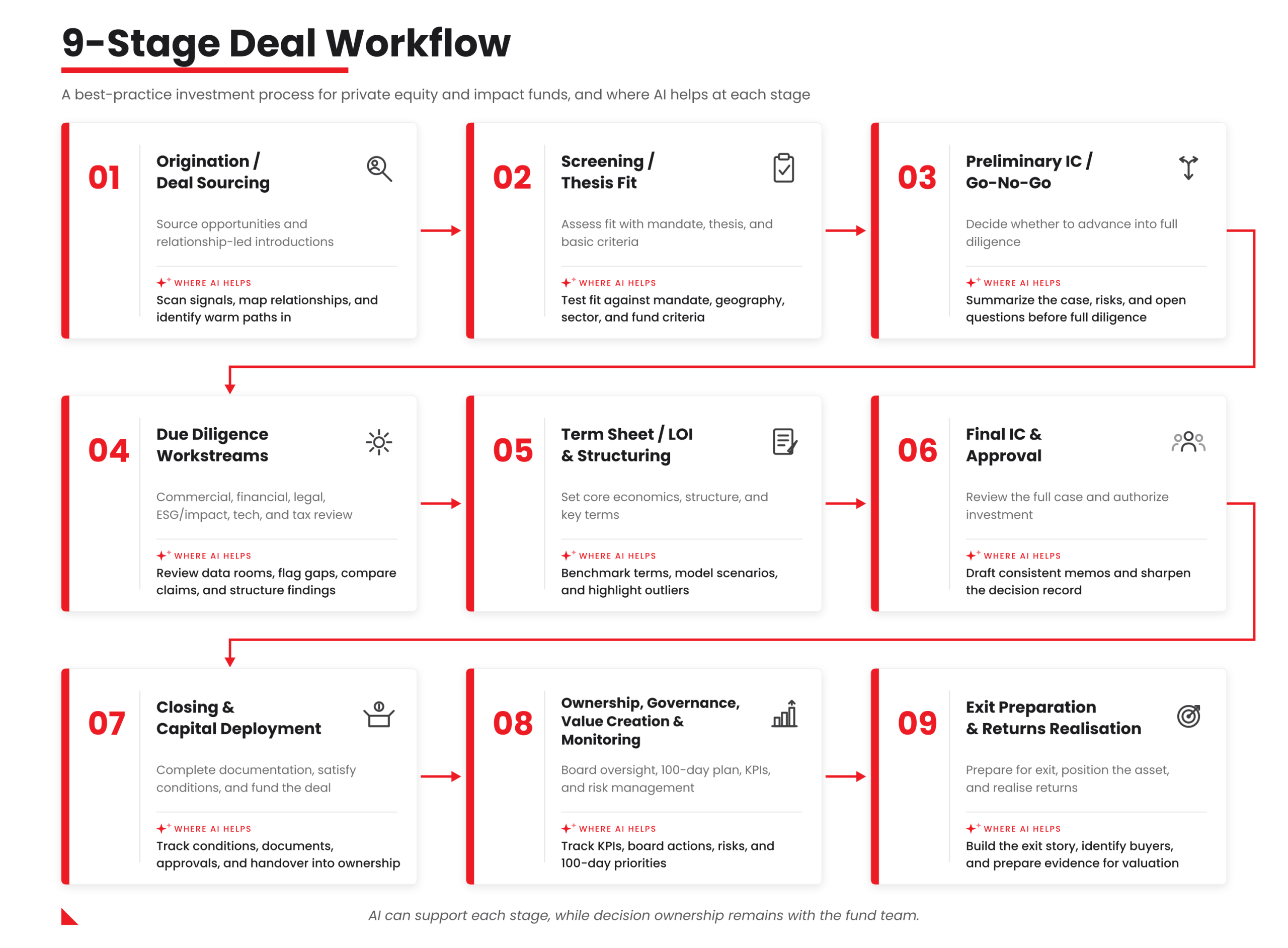
Fund AI.OS connects the two levels into one governed system.
Deal-level AI increases team capacity at each investment moment. Team-level AI makes that capacity repeatable, governed, and usable across the fund.
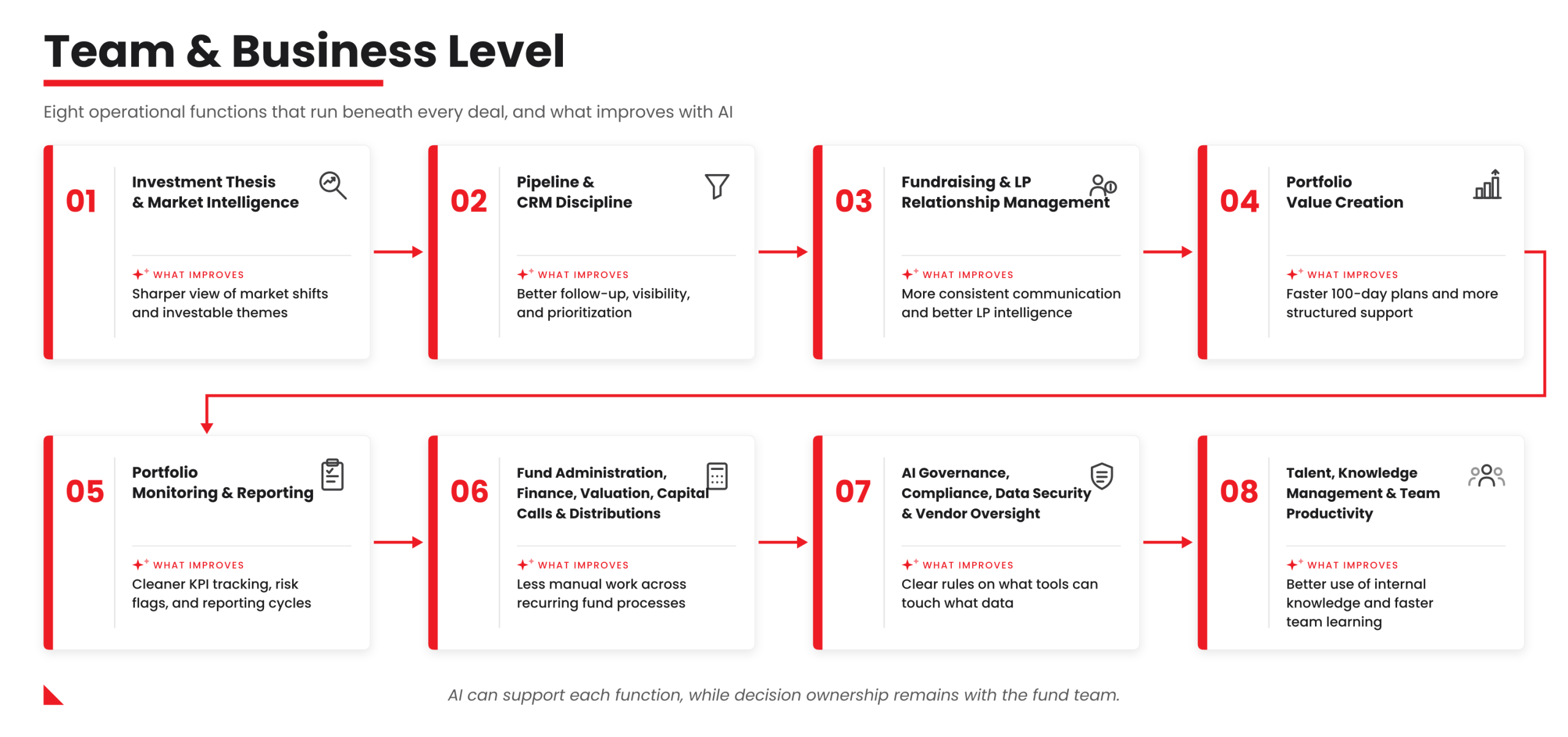
Eight functions.
AI designed in from day one.
The operational layer runs underneath every deal. It does not stop when a transaction closes, and it is where most funds leave AI value on the table.
We start every engagement with a current-state map: what AI tools are in use, what data they touch, and where the governance gaps are. Most funds find three things they did not know were happening. That map is the starting point for everything else.
We establish policy and oversight before we expand AI use. A fund that scales AI without a data classification policy and a clear ownership structure is building on exposed ground. We close that gap before we add capability.
Every tool we set up, we explain. Your team learns why it works the way it does and what to do when it does not. Tools handed over without understanding break at the worst possible moment.
We work with mission oriented funds between $100m and $300m AUM. These funds need AI tools built for local context, where data sovereignty questions are live, and where the firms we work with have direct accountability to LPs on responsible investment.
Start the conversation →On data sovereignty. When your analyst in Nairobi loads a confidential term sheet into a model hosted in Virginia, questions of jurisdiction, liability, and LP obligation become real. Most AI advisers will not raise this with you. We raise it before it becomes a problem.
On ESG commitments. If your mandate includes responsible investment standards, your AI use needs to be consistent with them. We build that into the governance framework from the start, not as an afterthought when an LP asks how you use AI to screen for ESG risk.